
The Complementarian-Possibilian Mindset: A Way to Rebuild Conversation in the Middle
A methodology for regaining our collective understanding and common sense.

Two-and-a-half years into LMF, after encountering many perspectives that not only differed from my own but also enhanced my understanding because of the differences, I needed a name for the kind of epistemological framework that was developing. As I was not seeking to debate or persuade, I grew more open to ideas that contradicted mine, and yet it felt much more than adopting a “nuanced take” on things. Then, on a morning walk in Casper, Wyoming, in June 2018, I heard the term “complementarity.”
I was listening to the physicist and Nobel laureate Frank Wilczek describe what happens when you look at light while moving toward it: it shifts toward the blue end of the spectrum. Moving away shifts it toward red. “All of these colors can be derived from one of them, simply by moving at an appropriate velocity.” In a really deep sense, he said, they are really the same thing, and “the existence of one implies the existence of all the others.” Their properties are connected, and you can observe how the differences belong to the same entity. But only if you move.
I had been thinking and writing about the grey areas of our collective understanding, where we might find common ground and a renewed national sense of self. I was trying to uncover the nuances missing and needed in our public conversations. But nuance kept falling short, as it is something you can observe while remaining in one vantage point without venturing too far from your own biases. Complementarity, as I saw it, requires movement. It requires that you actually occupy the other position — not simulate it from where you already stand, but move into it — in order to understand what that position sees that yours does not.
The term “possibilian” came later, delivered by the neuroscientist David Eagleman, who defined it as the rejection of dogmatism in both strict atheism and religious certainty.1 A possibilian celebrates intellectual humility and calls for the active exploration of unconsidered hypotheses. For my own purposes, I’ve expanded it to mean one who rejects certainty as a necessary pursuit, on the grounds that achieving it is neither possible nor useful. It’s the answer to Mark Twain’s warning: “It ain’t what you don’t know that gets you into trouble. It’s what you know for sure that just ain’t so.”2
Possibilianism is not agnosticism in the lazy sense, the shrug that says that no one can know for sure, so let’s not bother. It is an active intellectual posture. It recognizes what comes across as rationality is often confabulation: the mind acting as a lawyer to defend a decision already made, rather than a scientist reasoning toward truth.3 It acknowledges that, if a claim contradicts our models of the world, we instinctively demand more evidence before changing our minds, while a claim that fits what we already believe gets accepted and moved past rather swiftly. The possibilian watches for this natural tendency in real time, in herself, and names it when she finds it.
I call the combined stance complementarian-possibilian, in which I reject certainty as a necessary pursuit, and I accept that holding side by side two seemingly opposing ideas can enhance my understanding — but only if I am willing to move between them. This approach allowed me to examine the complexities in many topics that, in this cultural moment, have been rendered as mutually exclusive binaries.4
Tracing my own changes over time, long before I developed the stance’s name, shows how it had stemmed from lived experience rather than philosophical choice. I just didn’t have a term for it. In my adult life, I had gone from Christian to atheist to possibilian; from conservative to left-leaning moderate to “politically homeless”; from someone who believed women had a unique value to humanity, a belief I once used to argue against their serving in the military, to someone who thinks equal opportunity is the only coherent position.
I had gone from a purveyor of certainty to (I hope) a more careful peddler of doubt. Each of those changes required the willingness to examine a premise I had held as foundational, and to remain open to revising it when the evidence demanded. This is exactly what the complementarian-possibilian stance requires, and exactly what tribalism and relativism prohibit.
What it is not: the confusion with relativism and tribalism
When I first shared on social media about complementarity, the most common objection was that it rhymes with moral relativism. It does not, and the difference is essential.
Relativism holds that your framework is valid within its own terms and mine is valid within mine, and we cannot question each other’s premises because we are each inside our own closed system. Complementarity says the opposite: we must be willing to question the premises — including our own — and the movement between vantage points is precisely the mechanism for doing so. The premises need to be true. This is the condition that distinguishes the complementarian framework from the relativist one.
The clearest example from the LMF journey happened in a prolonged living-room conversation — not during a dinner party, and therefore unlikely to be performative and more likely sincere — when my host claimed that no Black person in the history of the United States has earned what he or she has achieved. He did not say “some” or “many.” Every instance of Black achievement, in his account, was the product of affirmative action, of external preferential treatment and accommodation. Furthermore, he cited the data in The Bell Curve, which purports to show that Black Americans have the historically lowest average cognitive test scores among major racial groups.
The implied premise beneath all of it was that Black people are different from other racial groups not only in degree — the way all individuals differ from each other — but in kind, such that they are constitutionally incapable of genuine achievement without external assistance. Can this be a complementary vantage point? Can Black inferiority be a “complement” to racial equality — a view that, if you move into it, reveals something true about the world that your own position misses? No. The premises need to be true. The premise that an entire population is constitutionally incapable of earned achievement is false. You cannot build a complementary view on a false premise, any more than you can build a house on sand and call it structurally sound.
Tribalism is relativism’s social cousin. Relativism closes the premise philosophically, while tribalism closes it socially and politically. What we are seeing in our national life at this moment is a race on both extreme ends to enforce a loyalty and a purity of beliefs that says: if you don’t believe in precisely these things in precisely these ways, you are not one of us. The Left was first to use cancellation to build coalition, but the Right has come to embrace the approach as well, if less formally. Those who fall into the Ambivalent Middle mostly stay silent, because the thing about being genuinely complementarian is that both sides end up suspicious of you, and you can’t have status in either group when you are suspected by everyone. They stay low and avoid poking their heads out of the foxholes for fear of getting shot in the face.
The insistence on purity, out of loyalty or in pursuit of power and prestige, at this moment in our national life disqualifies the questioning of any premises — which is the opposite of the complementarian practice and the direct enemy of honest self-government.
The strengths
The complementarian-possibilian stance produced, across 259 dinner parties in 50 states, something I would not have predicted when I left San Diego in February 2016: the willingness of strangers to tell the complicated truth about their lives to a Vietnamese American immigrant and veteran who cooked dinner for them and asked how they came to believe what they believed. That particular combination of identifiers granted me the status of an invested outsider-insider whose ideological leanings were harder to assume. The container I built for those dinners was, in retrospect, the complementarian-possibilian framework in architectural form. I had nothing for sale and no agenda to advance. As often as possible, including on the occasion above, I asked how people arrived at their beliefs, rather than argued with the beliefs themselves. To maintain their ease, I was also the chameleon who withheld without pretending. By learning about intellectual frameworks of ideas that opposed my own beliefs, I was able to follow the logic of someone’s reasoning without resorting to argument, and to ask questions instead of asserting counterpoints. Each of those conditions removed one of the mechanisms by which tribal purity enforcement operates. What remained, when those mechanisms were suspended, was conversation — the actual kind, in which both people were changed by what the other person said.
The stance was and is also generative in a specific way that nuance is not. Nuance, as I came to understand it, lets you stay in your own vantage point and acknowledge complexity from there. Complementarity requires you to move. My personal life long before the LMF journey, once again, provided fodder for understanding on this front.
The earliest instance that laid the foundation for this very gradual development occurred in 2005. I did not process all of this until years after the event, when I did so with much introspection and reconsideration. I was teaching that year, and during Spring Break I returned to Vietnam, the first time back since my family left in 1983 when I was 8. The main purpose of the trip was to visit my dad’s ancestral village, a few miles outside of Hanoi, where his remains were buried. Shortly before he died, he had asked my mom to return his ashes and bury them among his forebears, which then would encourage his children to come see the place for the first time. When he was 15, my dad’s family fled south when the Geneva Accord divided the two Vietnams; despite wanting to, he never returned in his lifetime, but he also never lost his connection to the village. My siblings and I are the first descendants on our paternal side to have been born outside of the Hanoi region in 26 generations. It was his final wish that we know our ancestral roots.
Growing up in Orange County, California, I internalized a black-and-white understanding of Communist Vietnam, the country that formed when North and South reunified. Within the world’s largest expat Vietnamese population, the civil war was understood as a contest between good and evil, and evil had prevailed. Over 138,000 refugees were resettled in the United States, in 1975, following Saigon’s surrender. In Vietnam, the new government sent hundreds of thousands to prison for re-education and afterward deprived them and their families of true citizenship. Hundreds of thousands more escaped by boat or died trying, causing a global refugee crisis in the late 1970s. In Orange County, in the late 1980s, every Vietnamese family we knew fell into one (or more) of these categories.
On my return to my dad’s ancestral village, I met relatives who had fought on the other side of the war. Until then, I had not met any as an adult capable of handling contradictions. They were not evil, and they were not fools. They told me things about themselves that the history I had grown up with had not contained. I came back and spent two years questioning the framework I had inherited without examining it, and it would take much longer to formulate relevant questions and know where to search for answers. At the same time, in 2005, I was reading some of the first book-length treatments of the war in Iraq and sensing an echo of having naively “pressed the ‘I Believe Button,’” as I described it to my friends with military experience. Consequently, in those first two years following the trip, I reexamined nearly every philosophical and moral premise that I had accepted without truly questioning. Most inquiries did not result in new beliefs or a moral crisis, but some did, such as the decision to leave my deeply held Christian faith. The costs of that were friendships, community, and a system of values, and for a while the losses were disorienting.
As I learned to see more clearly during the LMF journey, when I encountered new knowledge and perspectives on a daily basis, I already had a foundation beneath my feet. Instinctively, I knew that an examination of my own premises required movement, just as I had performed a decade earlier by putting myself into the shoes of my relatives in Vietnam. I needed to acknowledge that the things I did not know or did not consider valid might have been the very things that would enrich my existing understanding. The complementarian-possibilian mindset requires this honesty about what it does not know. Absolutists and fundamentalists are people who need certainty. They are not prepared to live in a place with doubts. The complementarian-possibilian is prepared to live there.
The weaknesses
I want to be honest about them, because a possibilian must. Doubt is genuinely hard to sustain. The comfortable thing is certainty, and certainty is what the tribes are offering in abundance. To live in a place with doubts is not comfortable. Anyone who tells you otherwise has not actually done it.5
The stance also does not scale easily from individual encounter to institutional change. The transformation that occurs at a dinner table between people who have suspended their certainties for three hours does not automatically become the transformation of the systems that produced what those people are navigating. The complementarian-possibilian mindset is both necessary and insufficient. It can only be a building block among many other kinds of bricks and stones. It is a personal tool and not yet one for policy. At the moment, our electoral system rewards those who espouse the extremes.
There is also a limit case, and I found it in the claims about Black inferiority from my host above. Some premises cannot be engaged on their own terms without validating them. The categorical claim that no Black person has ever earned what he or she achieved is not a vantage point from which one might learn something true that one’s own position misses. It is a closed premise built on a false foundation. The complementarian-possibilian is not suspended in perpetual neutrality. She has views. She has arrived at them through a specific process. She holds them with enough looseness to revise them when the evidence demands it — but not so much that they evaporate the moment someone pushes back. The premises need to be true. Determining which premises are true is itself a judgment, which the complementarian-possibilian must be willing to make and willing to defend. Again, the processes of questioning my own beliefs took years and, in some cases, are still ongoing.
Finally, the complementarian-possibilian stance is socially costly in a way that many people cannot afford, and that I could only afford during LMF because I was always leaving. You can refuse the tribal purity test when you are a transient. When you live somewhere, work somewhere, and raise children somewhere, your belonging often depends on the purity you maintain — and the complementarian-possibilian who refuses the purity test in a fixed community pays a real price that the traveler does not. The transient’s privilege and true open-mindedness are, in my experience, connected. Now that I’ve lived at one address for over four years — the longest at any address since I became an adult — I have found it harder to inhabit the complementarian-possibilian mindset. That is due largely to an absence of a great diversity of views where I live, in San Francisco, and also partly due to a desire to avoid confrontation over trivial differences in opinion in the context of friendships.
How it might be useful
The national public discourse has become a cage fight between two minority groups that often do not have the public interest in mind. The two extreme ends — roughly 18 percent on the Left and 21 percent on the Right, according to the 2026 Pew surveys — have captured the vocabulary and the ruling metaphors of the conversation, mostly through social media and a click-based media ecosystem that rewards controversy and capitalizes on anger and fear. Those extreme ends are 3-4 times more likely to post about politics than any other group. That combined 39 percent, through social media posting by “influencers” and ordinary citizens, prompts and sustains a certain kind of national conversation, and it is not the one that the majority of the country is actually having in its daily life.
The 2026 Pew Research Center Political Typology
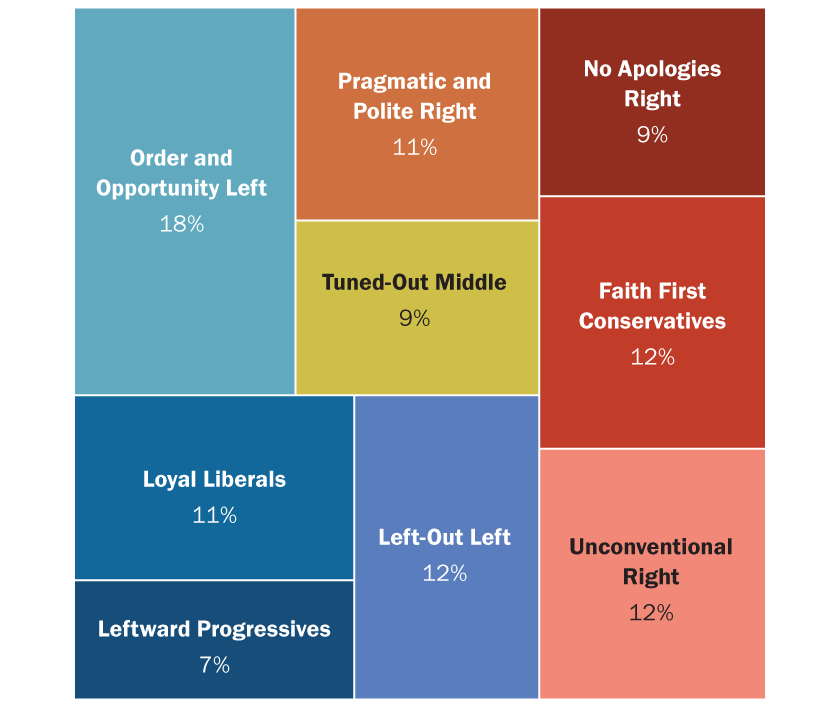
That middle space still exists and comprises the majority of the American public. It mostly exists in real life, in communities, at tables, in the daily negotiations of people who disagree about many things and still manage to live near each other and share the occasional meal. In our daily lives, we mostly function in this middle. But our thoughts and frames of mind have been co-opted by the language and dominant metaphors of the extremes. As a result, this bipartisan and non-partisan group has been named the Exhausted Majority by the organization More in Common,6 and it has lost the vocabulary for talking to itself, because the only vocabulary on offer belongs to the people doing the shouting.
It is worth mentioning that I had earlier referred to this majority as the Ambivalent Middle, a term I used in my travel journal and subsequent writing until I saw the updated depiction. It differs in name from the Exhausted Majority perhaps only because a chunk of the latter is characterized as far more cynical, resigned to a complete withdrawal from civic participation. It is a sign of the times that “ambivalent” is a hopeful term. Personally, I still call myself “politically homeless,” as I am actively resisting the temptation to throw in the towel, to surrender to my own exhaustion. I am instead seeking another way for us to rebuild community and society, even if only on the micro level to start.
To that end, what the complementarian-possibilian stance offers is not a political platform, and it is not an instruction to split the difference between two equally valid positions — which is what “both-sidesism” does, and which is a different and less demanding thing. It is a method. The complementarian-possibilian stance is a way to regain a common vocabulary, to move among perspectives and define what the actual disagreements are, and to devise policy that actually addresses those problems. It is the mindset that asks — before we argue with what someone believes — can we understand how they came to believe it? It asks this not as a rhetorical technique, such as steelmanning, used as a prelude to destroying their position more efficiently, but as a genuine inquiry. It requires the kind of generous listening that prepares us to be changed by what we find when we move into the other position. We can learn to ask questions and be ready for the other person to reveal something real from their vantage point that we have not seen from ours. We can learn that incorporating what they have seen would make our own understanding more complete, not less.
The task I see ahead is not only a resistance to the push toward the extremes. It is also an active fostering of the conversations that should be happening in the middle. These conversations require specific conditions to occur, because our national discourse has been so thoroughly colonized by the purity-enforcement mechanisms of both extremes that the middle has lost the habit of its own voice. It has also lost the ability to focus on the matters that actually affect the lives of the majority, obsessing instead on culture-war battles that increase one’s vanity virtue or influencer income but do not serve the greater public. As one writer has observed, we are fighting the wrong fights.
The complementarian-possibilian stance does not solve everything. It does not replace policy or law or the hard work of institutional change. But it can restore the voice and focus among those who are willing to dwell in the middle majority, those who are open to learning about how our differences can lead to better-informed personal understanding and public policy. When we refuse to stand still and can move among our differing perspectives, we might come to realize that all of the different colors are derived from the same thing, that their properties are connected, and that “the existence of one implies the existence of all the others.”
Frank Wilczek borrowed the concept of complementarity from the Danish theoretical physicist Niels Bohr. In the early 20th century, when quantum physicists encountered a new subatomic reality that defied their means to measure it, they were confronting two realities that seemed mutually exclusive and yet were equally valid, and the two could not be merged or resolved. Physics, Bohr argued, had to accept the seeming contradiction and simultaneously regard both things.7 He named this concept for the Latin complementum, “that which fills up or completes.” Accounting for these contradictions led Bohr and his contemporaries to new knowledge that otherwise would have been inaccessible or incomprehensible. The complementarian-possibilian stance adds to this scientific concept the acknowledgment that no human or system of beliefs can discover truth as a certainty, and therefore we need these apparent contradictions to reach a more complete understanding of our common reality.
The saying is often attributed to Twain, although without conclusive evidence.
Jonathan Haidt first wrote about this in his 2001 article “The Social Intuitionist Model of Moral Judgment,” and I encountered it in his 2012 book The Righteous Mind.
In The Master and His Emissary (2009) and The Matter with Things (2021), the neuroscientist and philosopher Iain McGilchrist also borrows Bohr’s complementarity principle and applies it to cognitive architecture in the brain. In the earlier work, he argues that the brain’s two hemispheres produce two whole, coherent, but incompatible ways of experiencing the world, and both are necessary to perceive reality. In The Matter with Things, he develops a related idea he calls coincidentia oppositorum — the coincidence of opposites — which refers to the longstanding philosophical insight that apparent opposites are not linearly irreconcilable (e.g., Yin-Yang) but tend to “fall together,” like how when two images are superpositioned and projected, they overlap precisely to form a new image. Whereas McGilchrist is describing cognitive architecture, I am describing a chosen mindset and practice for engaging across ideological lines.
I think of the poet John Keats’s “negative capability,” which he described in a letter to his brother as being capable of remaining in “uncertainties, Mysteries, doubts, without any irritable reaching after fact and reason.” In a place of such uncomfortable uncertainty, I have told students in my English classes, one can truly create. Keats was naming a poetic disposition, and I am proposing a method for engaging other people’s premises.
More in Common is an international, non-partisan non-profit that studies the root causes of political polarization and social fragmentation. Its sorting lists the non-compromising “wing Left” at 8% and the “wing Right,” with two distinct categories, at 25%. The remaining 67% fall into the Exhausted Majority. They have grown more cynical in the past decade, believing that neither party serves their interests or the interests of the citizenry at large. They are also flexible in their views and believe we can find common ground.
Here is how Richard Rhodes describes Bohr’s theory in The Making of the Atomic Bomb:
“The solution, Bohr went on, is to accept the different and mutually exclusive results as equally valid and stand them side by side to build up a composite picture of the atomic domain. Nur die Fülle führt zur Klarheit: only wholeness leads to clarity. Bohr was never interested in an arrogant reductionism. He called instead — the word appears repeatedly in his Como lecture — for ‘renunciation,’ renunciation of the godlike determinism of classical physics where the intimate scale of the atomic interior was concerned. The name he chose for this ‘general point of view’ was complementarity, a word that derives from the Latin complementum, ‘that which fills up or completes.’ Light as particle and light as wave, matter as particle and matter as wave, were mutually exclusive abstractions that complemented each other. They could not be merged or resolved; they had to stand side by side in their seeming paradox and contradiction; but accepting that uncomfortably non-Aristotelian condition meant physics could know more than it otherwise knew.” [The bold-faced emphases are mine.]
Rhodes, Richard. The Making of the Atomic Bomb. 25th anniversary ed., Simon & Schuster Paperbacks, 2012, pp.131-32.
Hi Steve. This is the first time I have read LMF and I must say I am impressed. Like Frankie’s comment, there’s much here to be considered and I will need to read it again to even begin to appreciate all you have to say. For now, I would like to share a way of thinking about the differences we share and how I came to better understand them. I was taking a graduate course on space science in the 90’s and was introduced to the concept of parallax. In astronomy, parallax is the apparent shift in an object's position when viewed from two different vantage points. Astronomers use this perspective effect to measure the distance to nearby stars by observing how they shift against the backdrop of more distant stars as the Earth orbits the Sun. It gets more complicated but understanding the complications are not necessary for my point.
What parallax made me think about is how each of us sees the universe of understandings, beliefs, and supposed realities differently based on where we are positioned in our human experience. That positioning is partly our own responsibility, and partly that of society, culture, and other factors which bend our ability to see what, perhaps, others see more clearly, or at least differently. We are looking, in effect, at the same night sky, but coming away with radically different views of what we are seeing based on our viewing position. For someone on the Northern hemisphere who has never seen the Southern Cross, and who has never heard of it, the Southern Cross doesn’t exist. For someone in the North who has read of the Southern Cross, they might believe it exists, but have a limited understanding of its beauty. Only when I traveled to Peru and was able to see it for the first time did the Southern Cross become real.
As long as we stay put among those with whom we view the universe in the same or similar way, much of what is out there is not there for us to see. Only by movement can one’s mind be open understanding other possibilities. My way of overcoming this deficit has been to travel to expose myself to multiple ways of seeing the world, but of course, there are other remedies as your article suggests.
I have always found my understanding of the human parallax problem helpful, but your article has opened my mind to other possible constructs, and for that I thank you.
You have presented me with a great deal to think about and ponder. I will
reread this essay several times…and think more deeply each time, I hope. Thanks for your insights. I truly appreciate your scholarship!
Frankie, the Aging Teacher