
“Life’s Pretty Precious”
A memorable interview with a retired coal miner in Lead, South Dakota.

A few days ago, on February 12 — incidentally, the tenth anniversary of the launch of Le Mobile Feast — the Environmental Protection Agency repealed the “endangerment finding.” The 2009 scientific determination, made in President Obama’s second year in office, states that “carbon dioxide, methane and four other greenhouse gases threaten human health, both now and in the future. These gases are released by the combustion of fossil fuels, such as when a car engine burns gasoline or a power plant burns coal.” In part, the Trump administration is seeking to “relieve the coal, oil and gas industries of pollution limits that cost them money.”
This turn of events reminded me of two noteworthy visits during LMF. The first occurred in South Dakota, where I met and interviewed a retired coal miner. The second took place in North Dakota, where I stayed on a family ranch with nine operational fracking wells on the premises. I share these stories now not to make any statement about policy or politics. Throughout the journey, I sought to understand better the lives and experiences of Americans all over the country, and how those experiences might have shaped their beliefs and values and, therefore, our collective values that often contradict one another.
Here is the first of two stories.
“Life’s Pretty Precious”
The smell of bacon woke me before the alarm did. I came downstairs to find Bob standing at the stove in the kitchen, flipping pancakes. Sherri was arranging eight varieties of fruit syrup on the dining room table — at least half of them produced in South Dakota, Wyoming, or Montana. Just one was maple, while some were regional flavors: chokeberry, boysenberry, prickly pear, wild plum, and one called Wahoo country cream syrup, made in neighboring Wyoming. In South Dakota, where I was in mid-June of 2018, berry season had just begun and would last into September.
I had a few minutes before breakfast, so I wandered into the nearby foyer and picked up a small book. It was Charles Windolph’s 1947 memoir, co-authored with brothers Frazier and Robert Hunt, called I Fought With Custer: The Story of Sergeant Windolph. The opening sentences grabbed me: two days after the Battle of the Little Bighorn, in late June 1876, the newly promoted Sergeant Windolph stood above the carcass of his commander, George Custer, “lying white in the Montana sun.” I was standing in the house that once belonged to Charles Windolph.
With much intrigue, I kept reading and was late in joining Bob, Sherri, and two other guests at the breakfast table.
I did not know any of this when I booked the reservation on Airbnb at 614 West Main Street, Lead, South Dakota. Throughout my three years on the road, I spent only 19 nights in paid lodging — either because I couldn’t find a host in a location I wanted to visit or for an event like a wedding. I wanted to see the Black Hills, Mount Rushmore, and the Crazy Horse Memorial, and I unknowingly chose perhaps the most famous residential home in the area.
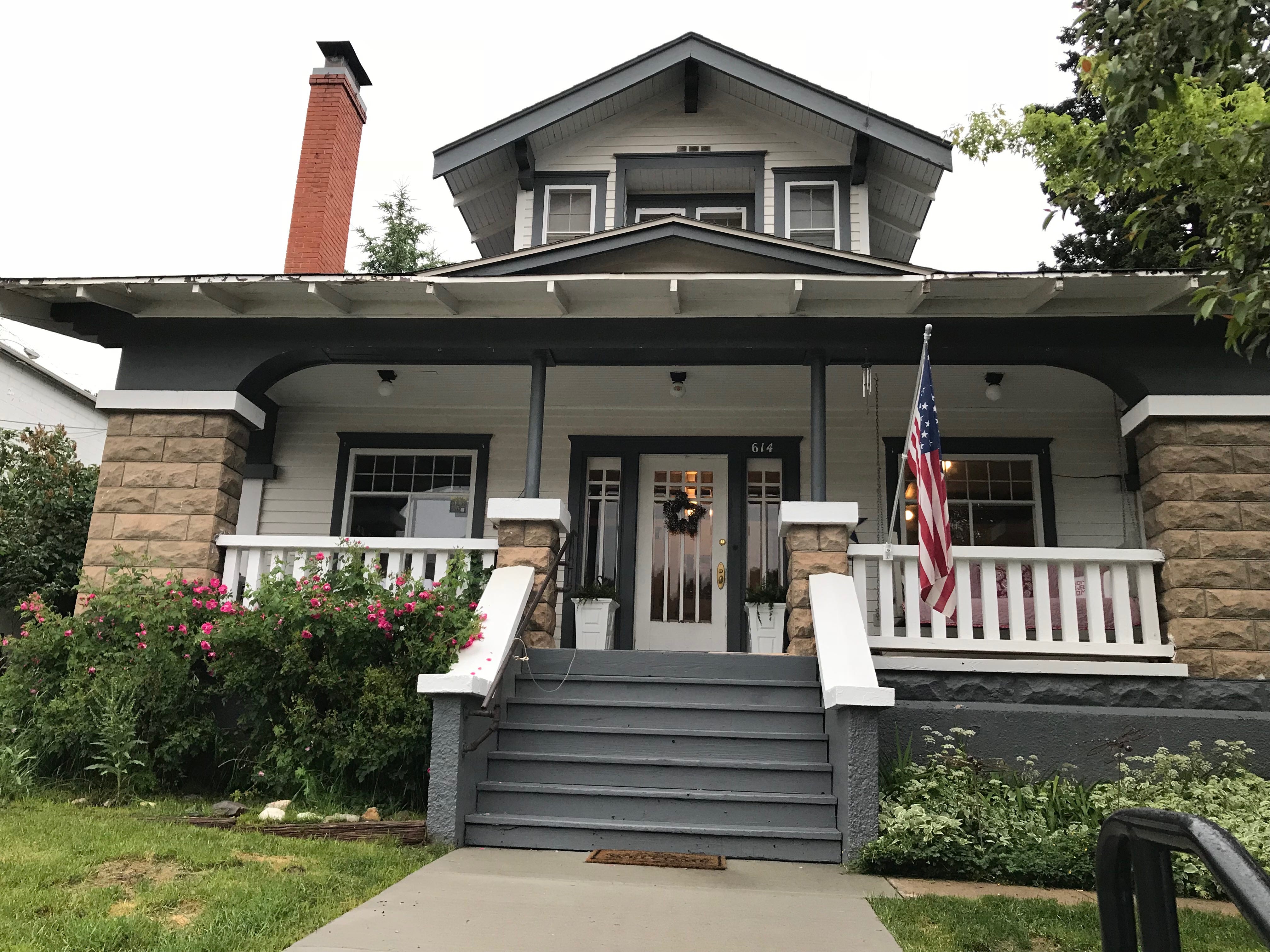
The house was registered as a historic landmark simply by its address. A travel brochure near the book explained that it belonged to “the last living soldier, serving under Captain Benteen, to see the Little Big Horn/Greasy Grass Battlefield between Crazy Horse and Sitting Bull and General Custer.” Windolph was awarded the Medal of Honor and the Purple Heart for his actions.
After leaving the Army, Windolph came to work for the Homestake Mine, in Lead, as a harness maker. He remained employed there for 49 years until his retirement. About halfway through that time, having earned enough for a comfortable life, he and his wife bought the house. It belonged to his daughter by the time Windolph died in it, in 1950, at 98 years old.
The current owners, Sherri and her husband, lived much of the year in Casper, Wyoming. In their absence, they left the property’s caretaking to their friend Bob, who was a licensed electrician and capable handyman. Bob was also a retired coal miner, although he had yet to draw from the pension from Peabody Energy. At the time of his employment, it was the largest coal mining company in the country by production. Peabody remains today the largest private-sector coal company in the world.
At the table, the other guests introduced themselves as Heather and her son Stephen. Heather came from near Sioux Falls, and Stephen lived with his dad north of Duluth. They took a vacation together every summer, and he’d just completed his junior year of high school.
I don’t think anyone brought up politics in particular, but the conversation drifted there anyway. Heather made an off-hand comment about how then-President Obama’s banking regulations helped empty Detroit and cities like it. She blamed them for the sudden drop in housing prices before the 2016 election. Bob chimed in that a friend’s 401k from a coal mining company had spiked to more than a million dollars in the year-and-a-half since Donald Trump became president. He attributed it to deregulation policies.
Sensing a kindred spirit in Bob, Heather vented her frustrations about African immigrants who had settled in the Midwest and were “boycotting” small businesses owned by white people, like restaurants and grocery stores. Instead of learning to love American food and culture — not just learning English — and assimilating quickly and fully, the immigrants had made life worse for the Americans who were already there.
I immediately thought about the concentrated areas of recent immigrants that I had visited in the previous months. The Twin Cities were home to the largest Somali population in the United States. One of the largest concentrations of Sudanese refugees lived in Omaha. While there I had seen the grocery stores selling spices, cuts of meat, and snacks I couldn’t find elsewhere. My host in Omaha told me that people in her part of town slowly but eventually adjusted to the newcomers, despite the language and cultural barriers.
I also recalled how Little Saigon came to be in Orange County, in Southern California. The area used to be mostly white until the influx of refugees after the end of Vietnam’s civil war. They, too, created business enclaves that catered to expatriated clientele who needed the comfort of familiar things like fish sauce. Most of them eagerly sought ways to assimilate and establish roots, but the lack of any work or credit history prevented them from getting mortgage loans. As a child, accompanying my dad to the Người Việt Daily News offices, which often doubled as a town hall, I learned about a program where people without access to credit deposited money into a shared account managed by a designated group. Those who needed a down payment for a house, for example, could borrow from it at low interest. In essence, these refugees created a parallel economy that would give them access to the mainstream one.
What Heather observed among the Sudanese and Ethiopians in Sioux Falls, I guessed, was mirroring what the Vietnamese did for the first decade or so after resettlement.
In conversations like this one, where I wanted to learn about other people, I kept these observations to myself. There would be time later to share them. At the moment I was curious about Bob’s career as a coal miner and his perspective on federal regulations.
Bob was a stocky man whose once-athletic build had softened somewhat in his late fifties. I could see several scars on his arms, likely from serious injuries and surgeries. He was also missing his right eye, and that side of his face was permanently deformed. Another story there, I thought. I was excited to hear more about his life.
After breakfast, I arranged to interview Bob with a recorder the following afternoon. That day, he said, he needed to run errands and make repairs around the house. I would spend the day driving through the Black Hills, visiting Mount Rushmore in thick fog, and spending several hours at the Crazy Horse Memorial.
When I told Bob about my plans, he mentioned that he had Native blood. “My grandmother was 3/4-Seminole and my grandfather was half-Cherokee. Both on my mother’s side. Father’s side was all German.” He also held strong opinions about the U.S. government’s long history of violating treaties with Native tribes, and a week earlier he had a “heated discussion” with another guest about the subject.
After just a few hours in his presence I knew he was a good storyteller and possessed detailed knowledge of a wide range of topics, a polymath. Like his dad, as I would learn the next day, he completed high school and became an autodidact for the remainder of his life. When we were just the two of us, he would ask as many questions as I did. At breakfast he had said that he retired after 12 years working for Peabody Energy, which was enough to earn him a pension of about $41,000 annually. If he waited to withdraw until he turned 65, that would increase to $60,000 or more.
The next afternoon, after we had eaten lunch, Bob and I settled into the living room. He sat on the couch and I positioned the microphone on the coffee table between us. I would discover later in a newspaper photograph that I was in an armchair almost in the same spot where Charles Windolph had sat when an Army colonel pinned the Purple Heart on his blazer, in 1946, seven decades late because of a clerical oversight.
Bob was born in Steamboat Springs, Colorado. While he was growing up, it was mostly a winter ski town, with businesses dying down through the summers. “Now it’s a year-round resort town,” he said, unrecognizable from what it used to be. He still had a cabin northwest of Steamboat. “To go to the cabin, I don’t even go through Steamboat anymore.”
His father spent a career in the Navy, served in World War II and Korea, and then retired in Colorado. As he got older, the seasonal construction work in Steamboat was hard for him. Winters were dull and dreary, and he was somebody who wanted to stay busy all the time. “He [once] had a few too many beers and finally decided it wasn’t for him anymore,” Bob summarized.
In the early 1980s, in the middle of the first coal boom, the family moved to Gillette, Wyoming. Bob was a sophomore in high school. Winter in Gillette was colder than Steamboat but without the snow, so his father could stay busy year-round doing construction and propane work.
Bob had plans to play football in college. Those plans changed in his senior year with what he called “a complete destruction” of his right knee. Plan B was to follow his father’s footsteps into the Navy. He made it through bootcamp fine, but early in his first year his knee blew out again, worse than before. The Navy discharged him.
By then his parents had left Gillette and bought land on the side of Laramie Peak, outside a little town called Wheatland. That was where Bob “came home” to from the Navy.
He was 19 and needed to clear his head and figure out why he’d had two amazing opportunities snatched away. He went to work for the Forest Service at the Douglas Ranger District, fighting fires through the summers for four years.
His first year, 1987, he spent the whole summer in Redding, California, and never got to fight a fire in his own backyard. The next year was different. He left the ranch on June 5 — his parents’ anniversary — and didn’t return home until Thanksgiving. That was 1988, and he was one among 25,000 firefighter and support personnel who combated the Yellowstone fires. By the end, over 793,000 acres burned, or 36 percent of the park. Ronald Reagan was president, and the “wilderness area” designation meant firefighters couldn’t use anything mechanized or aerial. Many of the fires started in remote areas they could not get to anyway.
“Eventually the fires got big enough that you didn’t have to get to them,” Bob said. “They got to you.”
It was nature’s course, he explained, but the problem was and still is that people keep moving further into the forest. “It becomes an issue of protecting life and property. You can’t just let things go the way they used to.”
The next two years were slower, and he got to stay home. In 1990, he went to work for a logging company with a big contract in Arizona. In the following year, he destroyed his left arm. He was chopping down a tree when another logger accidentally felled another one nearby. The second tree split — what’s called a “barber chair” — and the massive splintered half tumbled where it shouldn’t have, shoving Bob into another tree and nearly crushing his arm.
He underwent realignment surgeries and rehab for four and a half years. He couldn’t work during that time.
“Took a while to heal up from that one,” he said, the way you’d deliver a punchline to a joke.
He was in his late twenties and staying with his parents in Wheatland, where there was “an amazing physical therapist” who was just starting her business. “She had a real caring and unique way about her,” Bob said. By the time he got to her, his surgeons had given up on fixing his arm. She found another surgeon in Laramie who was able to do it. He underwent nine surgeries before rehabilitation could begin.
“I’ve had 29 total,” Bob said matter-of-factly. “Knee, arm, face, back.”
The face injury happened in 2004, when Bob was working at the coal mine for Peabody Energy. A friend from work had moved to Wyoming from Texas and had never hunted mule deer. Bob had some land secured and offered to take him.
“I had my four-wheeler, and we were both on it. We’re going down this trail and saw this nice buck, so John got off and walked down. I heard a shot, so I went down to try to find him. I was crossing this washout — not a river or ravine or creek bed, or anything — barely moving, maybe three miles per hour, and as I started going to the other side, something happened. The machine accelerated and went out from under me, tipped completely over, and then came down full-faced — the full weight of the machine — its nose right on my cheek. It shattered everything across here.” He swept his hand across his face from the nose to the ear. “To this day we’re not sure exactly what happened.”
He was life-flighted to Rapid City Hospital, where he spent five and a half months, three of them in a coma. The surgeons wired his face and jaw shut for a year and a half. He lost use of his right eye and had titanium plates in three different places in his head. “My nose looked way different before that,” he said, laughing.
“That slowed me down a bit,” he added. The accident was in November 2004. He didn’t go back to work until 2006.
After the reconstruction of his arm, Bob was teaching himself electrical work until a master electrician took him under his wing. “Hey, this won’t get your bones broken,” the man told him. He spent about five years employed by a sawmill in Colorado.
During that time, his parents were getting too old to live on Laramie Peak. “Their place was hard for people to fathom,” he said. They didn’t have phones and communicated with neighbors by dual-band radios. From the end of the pavement, you would drive 37 miles of gravel road to reach the house at 8,700 feet of elevation. They received mail three times a week. One winter they were snowed in for 22 straight days.
It took a lot of planning in the summer to make it through the winter. “We all had three freezers, a huge pantry, a lot of dried goods, a lot of powdered goods.”
In 1996, his parents moved back to Gillette into a retirement community. Bob also moved there because he had a feeling he needed to spend time with them. He made a living doing electrical work until joining the mine in 2000.
“Lost my father in 1999,” he said, “so it was a good decision. He fought and hung on in a deteriorated state longer than he should have. He went from 235 pounds when he was diagnosed to weighing 86 pounds when he died.” He was 74 when he succumbed to cancer. “It’s just a really insulting way to go. It’s not fair.”
I told him I also lost my dad in 1999, also to cancer.
Silence fell between us for a moment, and then he said, “It was 19 years ago yesterday.”
His mother had gone through a nasty battle with bladder cancer in 1997. They expected to lose her, but she prevailed. She lived until 2015. “She was the more determined, stronger spirit of the two,” Bob said. She was 86.
His parents got married in 1946. She was 17, and he, 22. “They were married 53 years and 16 days, when my dad died,” he said with pride.
“The reason why I can remember the date is because my dad never graduated high school, but he was a math wiz. He explained to me that the whole world revolves around numbers. His birthday was 7/4, and his birth certificate says he was born at 7:04 in the morning. His death certificate says he passed away at 6:18 in the morning, on June 18, or 6/18.”
“Kinda got the whole Mark Twain thing going on,” Bob joked, referring to how the writer had been born just after Halley’s Comet appeared in 1835 and died one day after it reappeared in 1910. A lot more precise than Twain’s timing, I thought.
Bob’s dad was a pilot in the Navy during World War II, and he flew the Grumman F4F Wildcat. After his service, he didn’t take advantage of the G.I. Bill. The family owned land, and he wanted to go back to ranching. He stayed in the Reserves and got called up to active duty for Korea.
The politics changed between World War II and Korea, Bob told me. “Different party in power, different way of thinking and fighting. For those guys to be called overseas for what was called ‘a police action’ — that wasn’t the case. So my dad was really demoralized. The last seven to eight years of his military service were very hard on him.”
He went back into the Reserves after Korea and ended his career in the late 1960s, after almost 20 years, earning retirement on points.
Until the day he died, Bob’s dad “was always about America, about doing the right thing.” Bob was careful here to say that unlike others from that era who were bigoted toward people from other countries, his dad was not.
He had served in the Pacific theater. Pearl Harbor was bombed by the Japanese, but he never blamed the Japanese people who were already in America. “He was open-minded enough to say he wasn’t worried about the guy he bought his peaches from. He was worried about the guy coming at him in that plane. That was the enemy, not the people who were here already.”
“He welcomed immigration, for being such a staunch Republican all his life,” Bob said. “‘If you want to come and do it right,’ he would say, ‘I’ll help you.’”
I asked Bob how he would describe his own politics.
“I don’t know if you’d call me ultra right-winged today,” he replied, “but I lean way right, for the most part.”
“Why do you think that is?” I asked.
He paused and took a couple of breaths. He seemed to be choosing his words carefully.
“Well, you can put corruption in the government on both sides. But I think there has to come an end to the free… uh… there has to come an end to the subsidies and the free ride that some of the left-leaning politicians want. We don’t have it to give. Fiscally we don’t have it to give. We have to slow down. We have to step back and… Um—
“You know, I’ve seen what I consider our biggest industries be choked off because of EPA guidelines or this or that. Without the coal, without the oil — I mean, if we become a country where we have to import everything, then we’re not a country anymore. We have to make something ourselves, you know. And Obama wanted to kill coal. Not a good program.”
“You don’t see —” I started before pausing, as it was my turn to choose words carefully. “To do away with coal doesn’t need to mean buying energy. We can produce different types of energy. Do you see any value in that?”
He explained that he saw wind energy as a supplement but not the answer. “The cost to set up the towers, to maintain them — they’re not cheap. There’s a lot of intricacies, and it’s an expensive process to build them, transport them, put them up. And then the maintenance cost.”
I recalled that he’d worked as an electrician for decades and that these opinions came informed.
“We have to be careful with coal, though,” he continued. “We don’t have as much as everybody thinks we do.”
“It’s a finite resource,” I said. “It took a couple million years to get that coal.”
“The oil is the same way. We’re gonna run out of this stuff eventually.”
Bob went to work for Peabody in 2000, one year after they bought the North Antelope and Rochelle mines and merged them. Today the North Antelope Rochelle mine sits in the Powder River Basin, south of Gillette. Eight of the ten largest mines in the United States are located in that basin, and NAR is the third-largest in the world.
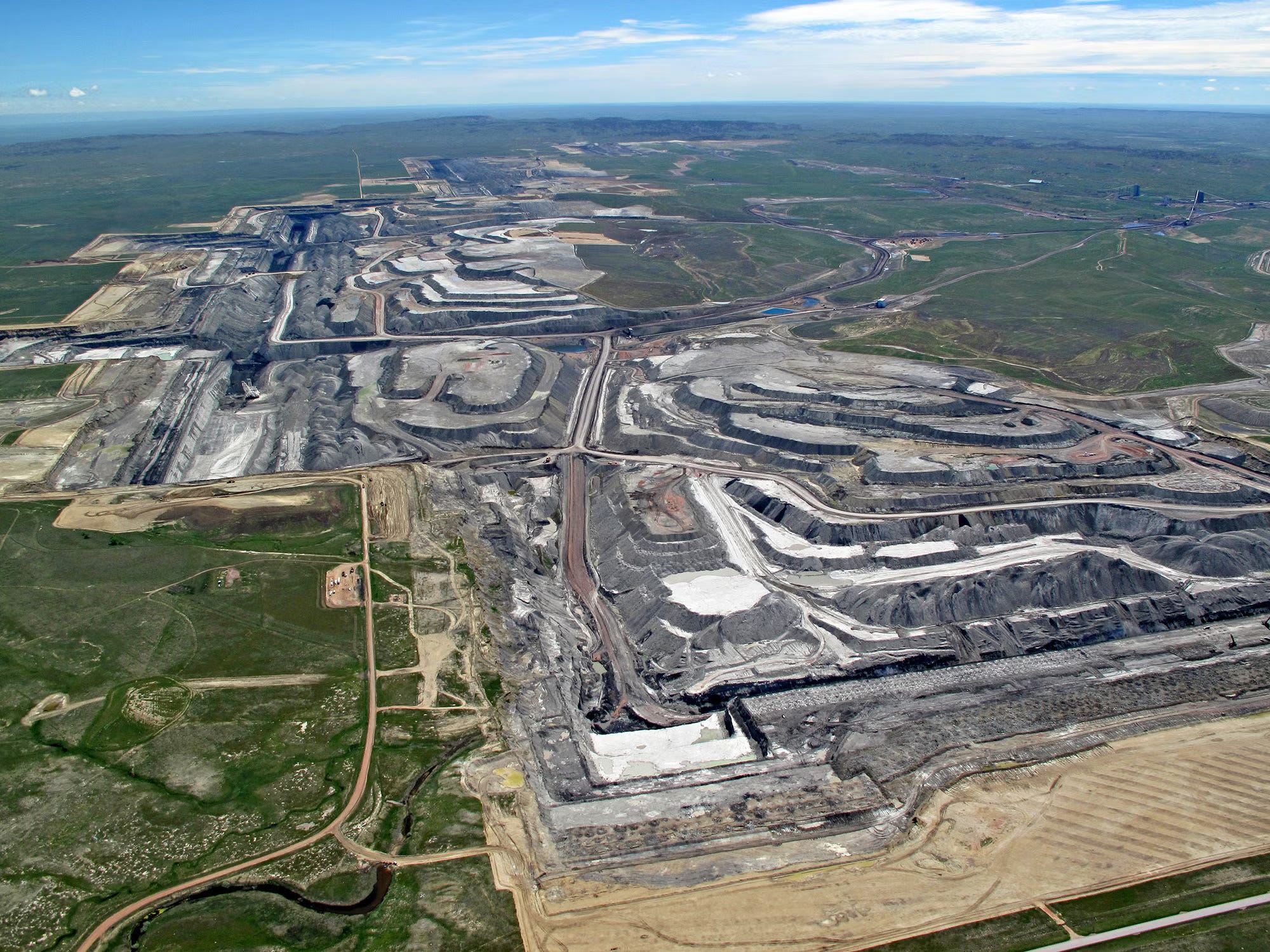
Like everyone else starting out, Bob drove a haul truck in what they called “dirt production.” He found out very quickly that driving a truck from point A to point B thirty-five times a day was not what he wanted to do. He would have quit if not for the year-round income and the benefits.
“When I started,” he said, “we had basically zero deductible on insurance. They paid for the prescription coverage. The most expensive prescription you could get at that time — even a cancer medication — was $15 for a month. So, huge draw.”
When a position opened up on the dragline crew, Bob applied and got it within four months of starting. He stayed there for the rest of his tenure. The work involved taking the coal pit and preparing it for the next phase — drilling, blasting, removing dirt and coal in a repeating cycle, 285 feet at a time. The longest pit while Bob was there was almost two miles long.
The dragline never stopped operating. They hot-seated for 12-hour shifts, and when crews changed from day to night, as soon as one operator rolled off the cut, the next was already waiting to fill the seat. The “dog house” on the dragline — that’s what they called it — had kitchens, break rooms, lockers, and toilets, so the workers never really stopped either. Living and laboring happened in the same machine. Bob lived in Gillette with a 1.5-hour one-way commute by bus, making for a 16-hour day from the time he left the house until he returned.
The shift rotation started on a Friday night. Three or four nights on, then days, then nights again — the cycle stretched across weeks in a rhythm that was easier to survive than to explain. “If I could have gone straight night shifts,” Bob said, “I’d probably still be there. I hated day shifts.” His worst time was the Monday-Thursday days, when the environmentalists, employee relations people, and engineers were out. “Everybody sticking their nose in everybody’s business. We couldn’t get anything done.”
I chuckled at the fact that, given the grueling work schedule and secluded life outside of it, the interactions with the environmentalists were the breaking point for him. He then clarified that the health problems also pushed him out of mining.
“If I’d known more ways to stay in better shape then, I’d probably still be there. I’ve seen people that look like they just came out of BUD/S in the Navy, and in six months they’d look 20 years older. It affects different people in different ways.”
I asked how they handled restroom breaks during a 12-hour shift.
“If you’re on the dozer, and you’re a guy, then you gotta do whatcha gotta do and step out on the track. If it’s ‘number 2,’ at every pit we had ‘dog houses,’ and porta-potties. We had them on the bottom or the top, whichever you were closer.”
When the dragline got to a certain distance away, they would move the dog house. In an emergency, he added, the workers would use a double-lined trash can and would take it out with them.
“Your bodily functions are like the weather: they’re the only two things you can’t control,” he said and laughed at his own joke.
In 2000, a good wage for road construction was $14 or $15 an hour. “You could walk into a coal mine knowing absolutely nothing and make $18.” Within a few years, Bob was making about $26 an hour. When he left, he was earning just over $32. Holidays were triple time. “There were a lot of times out there when we were making $2 a minute, if we wanted to work a holiday. It was $90 to $100 an hour.”
As with personal well-being, maintaining financial health required more discipline than many people had. “They’re not used to that kind of time off and that kind of money,” he said. He knew more than a few who fell into debt, spending extravagantly on new trucks or Harley Davidsons, and then they would need to work overtime to pay the bills. “You see [now] a bumper sticker in North Dakota and Wyoming, and it says, ‘Please God let the boom come back, I won’t blow it this time.’ But they all do.”
Things started changing around 2006, when the mining companies began to cut back. Insurance coverage decreased from 100 percent to 80-20. Deductibles increased, while prescription drug coverage decreased.
During the first Obama administration, the federal government invested in alternative energy, putting pressure on the coal industry. Additionally, natural gas became a fierce competitor on the market. In 2016, four years after Bob had left, Peabody filed for Chapter 11 to restructure its debt of over $10 billion.
“It’s still the best job in that area today,” he told me, “but it’s not the cash machine it used to be.”
The vesting period for pension changed too. Now it was 20 years instead of five. Bob got in at the perfect time.
Peabody also provided employees a 401k, with matching funds. At one point, however, its value “was almost nothing,” he said, “because of Obama — and the financial crash.”
According to Bob, the managers of Peabody’s 401k fund invested heavily in the California-based company Solyndra, a manufacturer of solar panels that, in 2009, received a $535 million loan from the Department of Energy through the American Recovery and Reinvestment Act. That signature law during Obama’s second year in office helped to stabilize the economy during the Great Recession. Two years after the loan’s approval, Solyndra filed for bankruptcy, creating a political crisis for the president. For Bob, who called Solyndra “Obama’s baby,” the episode caused him to lose trust in the federal government.
“It looked like a good investment for whoever Peabody hired on as investment brokers,” he said. “You don’t have a lot of control over where your money goes, you know. You do initially, but then — the thing I don’t like about the 401k is that your company is contributing to that, and they have most of the power as to where that money goes. To someone at that point in time, it looked like a good investment. We all know it didn’t turn out that way.”
Then, he commented about his best friend in Douglas, who worked for a different mining company, whose brokers evidently did not invest in Solyndra: “When Trump got into office, with his 401k he’s a millionaire now.”
There’s a subtle dance of culpability here and some slippery connections: President Obama became associated with the financial crash of 2008, and he got blamed for Peabody’s investment brokers putting 401k money into Solyndra, and then President Trump got credit for the stock market’s recovery.
In Bob’s eyes, the federal investment in green energy was a “big fraud,” benefiting the president’s allies. Indeed, a major donor to Obama was the largest private investor in Solyndra, with his family foundation owning 35 percent of the company at one point. I was not quick enough to ask Bob in the interview how he felt about that person losing a fortune when the company folded after defaulting on the federal loan.
“The green energy, the electric cars —” he continued, “the problem is that we’re just not willing to sit back and settle for that. We still have too many people who like their big pickups.”
I appreciated Bob’s implied logic, that the investment in green energy was not a bad one because green energy did not have a future. It was a bad one because Solyndra turned out to be “a fraud,” and this country’s culture had not reached a saturation point with green energy to make such investments profitable. He was complaining not about the technology’s future, but about the dumb decision in 2009 to invest in a sector whose market concept had not been proven.
“I won’t say I keep my money under my mattress,” he half-joked, “but I keep it pretty close.”
“You think like a refugee,” I said and laughed. “I might know people who still keep money under their mattresses.”
Bob left the mining job in 2012 and went to Casper, Wyoming, close to his mother, whose health was declining by then. At the time, Sherri was working for a state organization that provided care for elderly or disabled people so that they could stay in their homes.
“She’s very compassionate, very caring,” he said, “and she would cut through the red tape of the bureaucracy and get these people what they needed. And she helped my mother. That’s how I met her.”
In 2013, Bob moved to Deadwood, the twin mining town next to Lead, to work for the city. That same year, Sherri and her husband bought the historic home of Charles Windolph. Her husband worked for the oil industry at the time and stayed in Casper, and Sherri would split her time between the two homes. When the job in Deadwood did not pan out for Bob, she offered him a place to stay at the house in exchange for his maintenance of it in her absence.
“This house had been broken into numerous times before Sherri bought it,” he said, “and then an attempt to break in one time after. That won’t happen again. You can’t replace anything, with this being an old historic home, so you have to protect it. And it’s just better to have somebody here all the time.”
In July of 2015, they turned the house into a bed-and-breakfast. Their first foray with renters was that summer’s 75th Motorcycle Rally in Sturgis, when 1.2 million people attended. The BnB was fully booked the entire time. The first foreign guests came from South Africa. Since then, they’ve had visitors from China, Japan, Vietnam, Korea, Australia, Canada, Britain, Kenya, New Zealand, Zimbabwe, Poland, Belgium, Germany, France, Sweden — and a bunch more Bob couldn’t remember.
After I turned off the microphone, Bob asked about my upbringing. I told him the story of my family arriving in the United States as immigrants in 1985. I explained how my parents made a downpayment for a house with low-interest loans from friends and family because they did not have enough credit history to obtain a bigger mortgage.
Bob was quiet for a moment, and then he returned to what Heather had said on the previous morning about the African immigrants who had settled in the Midwest and were “boycotting” small businesses owned by white people. He did not respond to her in that moment, but now he was telling me that he was “uncomfortable” hearing those things.
“That’s what immigrant groups need to do,” he said. “They have to help each other get established, create their own systems until they can access the mainstream ones.”
He then admitted that many of his “right-winged” fellows would agree with Heather.
As we wrapped up the interview, Bob crossed the room and retrieved something that had been on display. It was a lunch pail his grandfather used to carry into the coal mines in Oklahoma. His grandmother had passed it down to him.
The whole thing, when assembled, looked like a lidded tin bucket. Bob asked me to guess what it was. I joked that it was a chamber pot. He laughed and removed the lid, then the two layers of storage inside. Ice would go into the bottom of the pail. The main course — sandwich, meats, anything that might spoil in the heated mine shafts — would sit above that. The top pan could hold dessert, cigarettes, anything you’d want to keep dry.
It was about 100 years old.
Bob held it carefully, turning it over in his hands. It helped him to connect with his grandfather, another coal miner whose backbreaking labor helped to industrialize the country.
****
Last April, when I started working on three different stories about my stay in Lead, I had several questions to ask Bob for this one. My texts to him went unanswered for several days, which seemed unusual. I then sent one to Sherri to ask how they both were doing. She quickly replied to say that Bob had died a few weeks earlier after a three-month hospitalization for complications from kidney disease. In our interview, Bob had mentioned consuming a lot of opiates during the recoveries from many of the 29 surgeries, and that he was worried about his kidney and liver.
I sat at my desk in a moment of silence to honor him. I’m not sure why, but I immediately hoped that he had started to withdraw from his pension, that the 12 years of digging the earth had finally yielded the hard-earned treasure. Then, I returned to these words in my transcription of the recorded interview.
“The way I go through life is to try to make every day a good day,” he said. “I instill this in Sherri. She sometimes gets wrapped up in a little thing, and it’s like, ‘Look, relax, because we don’t know what’s coming tomorrow. If you have someone in your life, you tell them you love them every day. You always say goodbye. You always make sure you don’t leave anything undone. Life’s pretty precious.’”